An industrial fire nearby: what could be coming out of your A/C registers
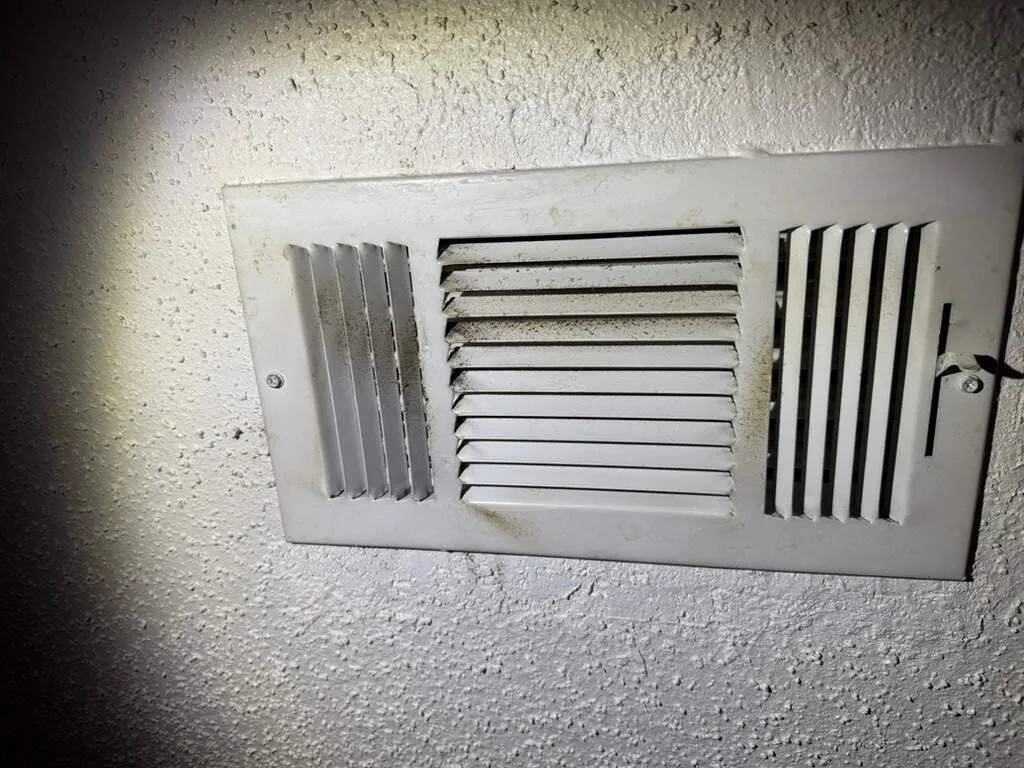
The fire is out, the smoke has cleared, and the news has moved on. But you keep noticing things. A gray film on the porch rail. Dark smudges around a ceiling vent. A faint smoky smell when the A/C kicks on. Maybe a filter that came out darker than it should have.
You’re wondering what’s in that dust, whether it’s inside your house, and whether you need to do anything about it.
Here’s a calm, straight look at what public agencies have found after comparable industrial fires, what you can do yourself, and when it makes sense to have your A/C and your house looked at.
How fire residue gets inside
When a large industrial or refinery fire burns, the smoke plume carries soot, ash and other particles downwind. Some of it settles on roofs, cars, porches and yards. Some of it gets pulled inside through doors, windows, attic vents and gaps in the house. Your A/C moves a lot of air, and its filter, coil, return and registers are where that dust tends to show up first.
The cleaning standard our industry follows for fire and smoke work, ANSI/IICRC S700, covers buildings affected by a fire in a neighboring building or nearby, not just fires inside the house. Section 7.2 makes two points worth knowing. An A/C system can pick up combustion particles whether it was running or off during the event. And soot in a house doesn’t automatically mean the A/C system itself was affected. That’s why someone has to actually look.
What agencies found after comparable fires
None of the agency reports below sampled the inside of anyone’s A/C system. They sampled outdoor air, soil, outdoor surfaces and, in some cases, indoor air. They’re still the best public guide to what fire residue can contain and what officials told residents to do.
- A lubricant plant fire in Illinois (2021). The county health department said ash and debris “visibly impacted homes and areas in proximity to the fire.” State agencies took more than 95 wipe, ash, soil and waste samples, tested “for metal compounds, volatile organic compounds, and/or semi-volatile compounds.” The state reported that all but one sample, a wipe sample close to the plant, “tested below the residential exposure limit,” and that one sample showed chromium above that limit. (Illinois EPA; State of Illinois; county health department, archived)
- A chemical tank fire in Texas (2019). Outdoor air monitors picked up benzene, a volatile organic compound, and a shelter-in-place order was issued. The state health department later concluded that short-term outdoor exposure to those compounds “is not expected to have harmed people’s health,” and noted it did not have data on other media. (EPA; Texas DSHS)
- A train derailment and controlled burn in Ohio (2023). EPA sampled soil for dioxins and other compounds “deposited in soot and ash” and concluded residents “can continue to use their properties for normal use.” Its indoor cleaning program used wet-wiping, wet-mopping and vacuuming, and EPA said that per health agencies, “duct cleaning is not necessary.” (EPA soil sampling; EPA home cleaning)
- A refinery fire in California (2012). The regional air district said “the likely source of health impacts from the fire is particulate matter from smoke,” and that smoke may affect downwind neighborhoods where there are no monitors. (Bay Area AQMD)
The pattern across those reports: soot, ash and fine particles are the main thing residents deal with, and what’s in them depends on what burned. We don’t make health calls. Follow what your local health department and the agencies say.
What you can do yourself
These steps come straight from public agency guidance:
- Change your A/C filter. EPA recommends a high-efficiency filter, “such as one with a Minimum Efficiency Reporting Value (MERV) 13 rating, or as high a rating as your system fan and filter slot can accommodate,” and changing it more often after smoke. Wear a mask and gloves when you handle a dirty filter, as the Illinois county health department advised. (EPA)
- Clean the right way. EPA says to avoid dry sweeping or dusting, mist hard surfaces before sweeping, follow with wet mopping, and use a HEPA vacuum if you have one. (EPA)
- Skip the odor machines. EPA advises against products that add chemicals to the air to neutralize smoke odor, “such as ozone and hydroxyl generators.” (EPA)
- Don’t assume the ducts need cleaning. EPA says ducts should be cleaned “only as needed,” for example if they’re clogged with debris or particles are actually coming out of the supply registers. (EPA)
EPA also suggests getting professional help if “the HVAC system is impacted, or the scale of cleanup is more than you can manage on your own.” (EPA)
When to have it looked at
- Dark residue on supply registers, the return grille or the inside of the filter slot
- A filter that comes out much darker than usual, more than once
- A smoky smell when the A/C starts that doesn’t fade
- Residue on window sills, ceiling fans or attic insulation
- You just want a clear answer and a record of your house, either way
How we handle it: three steps
1. Look and photograph. We look at the A/C system, the registers, the return, the filter, the attic and the surfaces where residue settles, and we photograph everything. Our first assessment is free, with no obligation. You keep the photos and our notes whether you hire us or not.
2. Order lab work only when it’s called for. If what we see needs an answer a camera can’t give, we order independent, disinterested third-party lab testing, such as a soot, char and ash analysis of a wipe or tape-lift sample. The lab report comes to you.
3. Clean what needs it, and nothing that doesn’t. If cleaning is needed, we follow the ANSI/IICRC S700 standard: test-clean first, photograph before and after, then clean what’s affected. If your ducts don’t need cleaning, we’ll tell you that.
What life looks like after
You know what’s in your house and what isn’t. The filter is fresh, the surfaces are clean, and you have photos and, if it was needed, a lab report. Whatever you decide, you decide it with facts.
Call for a free first look
Call (504) 702-1480. We answer day or night.
See our fire and smoke damage restoration, our air quality and duct work, or check the towns we cover.
More from Field Notes: – That musty smell when the A/C kicks on, and what it usually means – Sweating ducts: what the water in your attic is telling you
Questions about fire residue and your A/C
Can soot from a nearby fire get into my A/C? It can. The IICRC S700 standard notes an A/C system can pick up combustion particles whether it was running or off. Soot in the house doesn’t automatically mean the system was affected, though, so it needs to be looked at.
Do I need my air ducts cleaned after a nearby fire? Not automatically. EPA says ducts should be cleaned only as needed, such as when they’re clogged with debris or particles are coming out of the registers.
What filter should I use after smoke? EPA recommends a MERV 13 filter, or as high a rating as your system can handle, and changing it more often after smoke.
Do you do the lab testing? No. When lab work is called for, we order independent, disinterested third-party testing, and the report comes to you.
Restoring what
was lost.
Your comfort, your air, your home, back the way it should be.
Got a question like this one?
Tell us what you’re seeing. We’ll call you back.