A moldy smell, and nobody can find the water
The smell hit you the moment you opened the door. Damp. Moldy. You checked under the sinks. You looked at the ceiling. You walked the outside of the building looking for a leak. Nothing. No puddle, no drip, no stain you could point to.
That’s the call we got this summer from the owner of a small rental in Mid-City, a little apartment behind the main house. “It smells moldy, and we can’t find the water.” They were getting ready to sell the property and wanted it handled honestly before it went on the market.
Here’s what we found, and why a moldy smell with no obvious leak is more common than you’d think.
Before we got there
On the phone, we worked through what it probably wasn’t. The unit sat on a slab, and nobody had ever seen water beading on the floor, so moisture coming up through the slab was unlikely. The working idea going in was that something was coming in from the attic side. Nobody had ever looked at it with a thermal camera. We were the first company they’d called.
Our first look was free: walk it, use the thermal camera, sketch the layout, talk through what we see. No demo, no cutting holes until there’s a reason to.
What we actually found
There was no hidden pipe leak and no roof leak. The water was already in the room. It just wasn’t coming from where anyone expected.
- The bathroom was the real problem. It had heavy surface growth from condensation. Every shower filled that small room with steam, and with no exhaust fan, the steam had nowhere to go but onto the walls and ceiling.
- The front door had light staining at the entry, from a seal that wasn’t doing its job.
- The staining above a window wasn’t mold. It was wood oils bleeding through the trim, the same as on other trim in the unit.
- The mini-split had light spotting, normal for a mini-split that’s overdue for a cleaning.
So the “mystery water” was shower steam. The fix had to deal with the bathroom and give that moisture a way out.
Why you can’t find the water
A moldy smell without a visible leak usually means one of these:
- Condensation. Steam from showers and cooking, or warm humid air meeting a cold surface. It looks like nothing until the growth shows up.
- A slow leak inside a wall or ceiling. A supply line, a drain or a roof flashing that drips just enough to keep things damp.
- The A/C system. A clogged drain line, a sweating duct or a dirty coil.
- Old water that was never dried out. A past leak that got painted over.
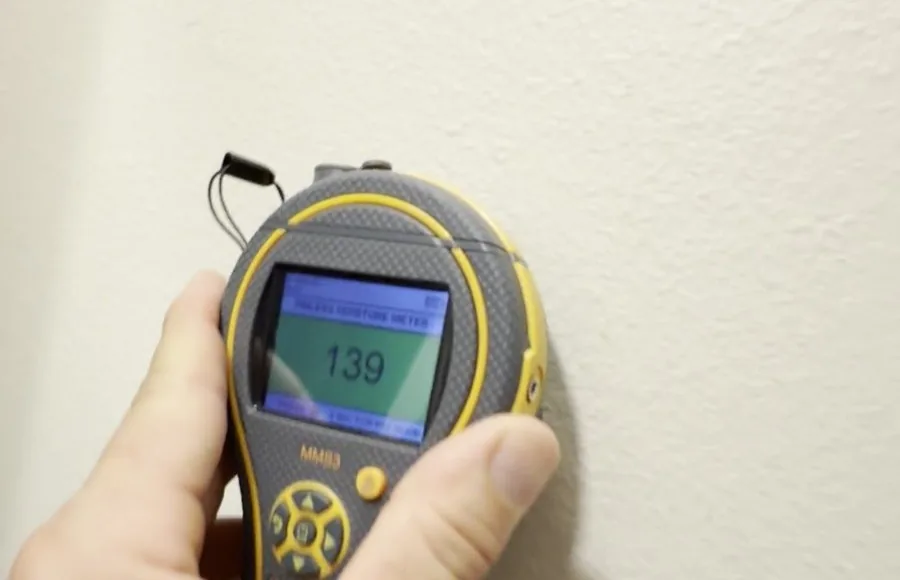
The only way to sort them out is to look with the right tools: a moisture meter, a thermal camera, and someone who knows what a dry wall and a wet wall look like on the screen.
What’s at stake if you guess
If you guess wrong, you pay to fix the wrong thing. Someone tears open a wall looking for a leak that isn’t there, or bleaches the bathroom and paints over it, and the smell is back in a month because the steam still has nowhere to go. If you’re selling, a moldy smell at a showing tells buyers there’s a problem you haven’t solved.
How we handle it: three steps
1. Find the moisture first. We walk the property, use the thermal camera and moisture meter, and photograph everything. You get our read on the source, in writing, before anything is cut open.
2. Fix the source, then the mold. On this job, our plan was mold remediation in the bathroom with HEPA vacuuming and proper treatment, a new seal on the door, a cleaning for the mini-split head, and an always-on, moisture-sensing exhaust fan wired into the bathroom. We were plain that the fan is the piece that keeps it from coming back.
3. Confirm it. When a mold assessment is required, we order independent, disinterested third-party testing before and after, so the clearance call belongs to someone who didn’t do the work.
What life looks like after
You open the door and it just smells like a room. The bathroom stays dry after a shower. And if you’re selling, you can tell a buyer exactly what was found, what was done, and why it won’t come back.
Smell something you can’t find?
Call (504) 702-1480. We answer day or night. Tell us where it smells and when it’s worst.
Learn about mold remediation and assessment, or see the towns we cover.
More from Field Notes: – That musty smell when the A/C kicks on, and what it usually means – Sweating ducts: what the water in your attic is telling you
Questions about a moldy smell with no leak
Can a bathroom with no exhaust fan really cause mold? Yes. On the Mid-City job, shower steam with nowhere to go was the whole source. A moisture-sensing exhaust fan is the fix that keeps it from coming back.
Is all dark staining mold? No. On that same job, the staining above a window was wood oils from the trim. Someone has to look before anything is treated or torn out.
Will you cut into walls to find the water? Only if the readings point there, and only after we tell you why and what it costs. The first look is free.
I’m selling. Should I deal with a moldy smell first? It’s usually worth it. Finding and fixing the source, and having a record of it, is easier than explaining a smell at a showing.
Restoring what
was lost.
Your comfort, your air, your home, back the way it should be.
Got a question like this one?
Tell us what you’re seeing. We’ll call you back.